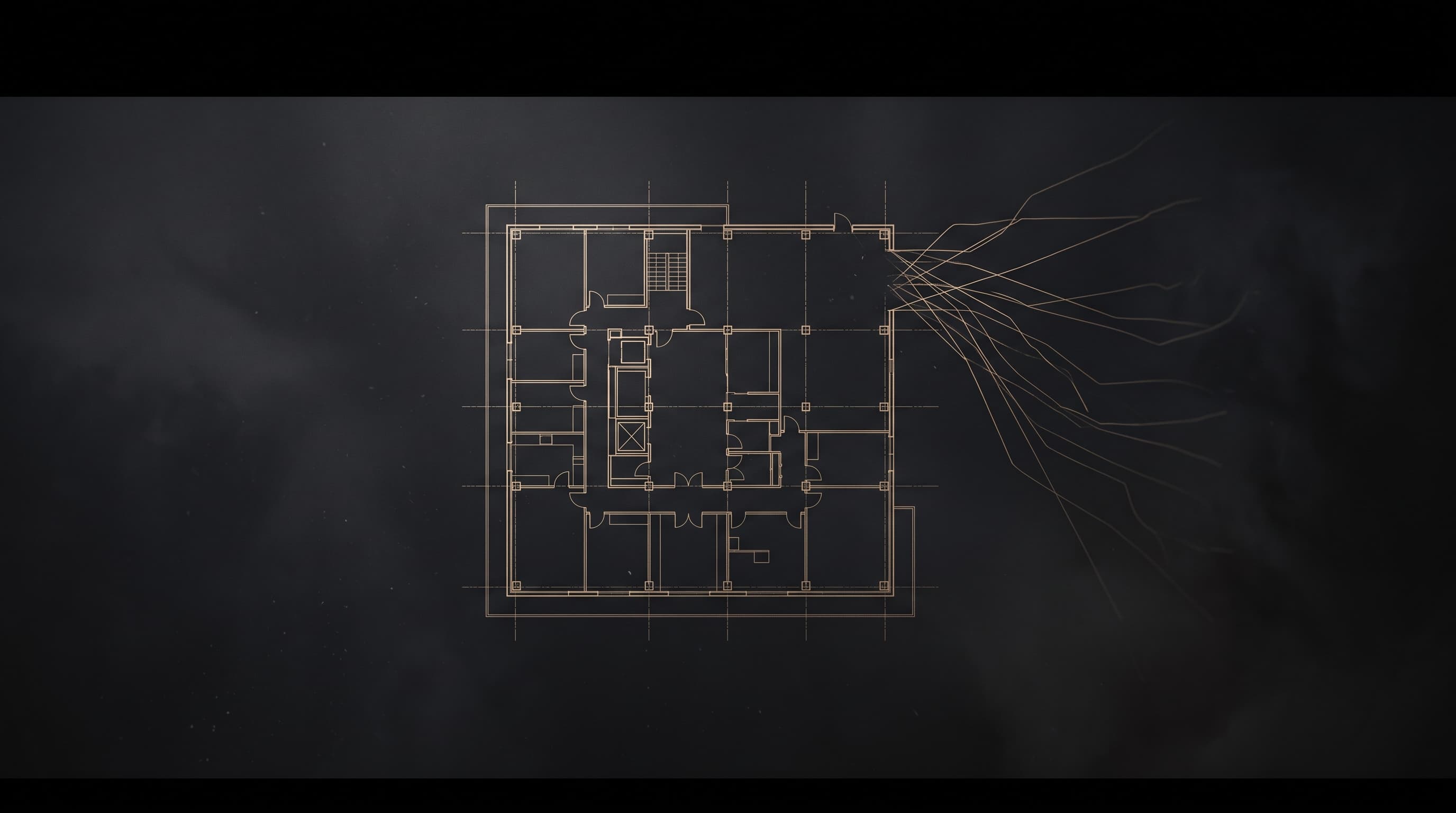
The Process That Lives in One Person's Head Succession Risk Wearing the Face of Efficiency
In retail operations, the institutional knowledge that holds a replenishment cycle or a vendor negotiation together often lives entirely with one tenured person. This brief examines how to find those single points of failure before an AI implementation finds them first, what documentation work actually has to happen before a model can be trained on a process that has never been written down, and what the leader approving the report is rationalizing every Monday morning she forwards it without asking.

Quick answer
Wednesday, 10:20 AM. A process walkthrough session, midway through. The analyst is presenting the supplier reconciliation report: one Excel file, multiple tabs, different team members built different sections. I ask where the figure in column G comes from. The analyst pauses. Looks at the tab. Says the person who built that section is out this week. Someone says we can take it offline. The session continues. Column G has been off by a rounding error for six weeks. I had written 'follow up on column G' in my notes three times before this meeting. After the session ended, I closed my laptop and moved to my next call. The follow-up did not happen that day. That moment is what this brief is about. Between 60% and 80% of enterprise operational processes are either undocumented or documented only in informal formats (PMC/NCBI, 2025). In retail operations, the gap concentrates in the people with the most tenure and the least bandwidth. Before a model can be trained on a replenishment cycle or a vendor reconciliation workflow, someone has to write down what actually happens, including the manual corrections, the exception logic, and the adjustments that never made it into the system. The person who knows all of that is usually still doing it. And the leader who could ask about it is usually forwarding the report without asking.
TL;DR
Five findings that frame the argument:
Most processes are not documented
60-80% of enterprise operational processes are undocumented or exist only in informal formats like email threads and verbal agreements (PMC/NCBI, 2025).
The knowledge is genuinely singular
42% of institutional knowledge is unique to the individual who holds it, not documented anywhere and unknown to colleagues (Panopto Workplace Knowledge and Productivity Report, via HR Dive, 2018; replicated by IDC through 2024).
AI pilots fail on this gap at a measurable rate
70% of AI implementation failures trace back to process and people gaps, not to model capability (BCG, 2025). MIT research puts the generative AI pilot failure rate, measured by documented financial returns, at 95% (MIT NANDA Project).
Retail AI readiness scores are low across every operational dimension
Retail talent readiness for AI averages 3.9 out of 10 across the industry; governance averages 3.1 out of 10 (Forrester, State of AI in Retail, 2025). Only 11% of retail organizations say they are ready to scale AI (Amperity, 2025).
The cost of doing nothing compounds with every departure
Companies lose approximately 42% of institutional knowledge every five years as employees turn over, and replacing a single employee costs 50%-200% of their annual salary (Panopto/IDC, 2024; Gallup, 2026).
Most C-suites know this is a problem and have done nothing
58% of C-suite respondents in an APQC survey (October 2025) described themselves as very worried about knowledge loss. 92% of those same organizations did not consistently capture knowledge from employees nearing departure.
What happens in the walkthrough session
Wednesday, 10:20 AM. Let me stay here for a moment, because this is where the problem lives. The analyst presenting the summary report did not build the underlying tabs. Multiple team members own different sections of the same Excel file. When I ask where a specific figure comes from, the presenter pauses, looks at the tab, and says the person who built that section is out this week. Someone says we can take it offline. The session continues. Column G. Off by a rounding error for six weeks. The note to follow up written three times before this meeting. After the session, I close my laptop. My next call has already started. The offline conversation never gets scheduled. In my experience across corporate engagements, 'take it offline' functions as a polite close on a question that nobody in the room wants to answer in front of everyone. The real detail, when it surfaces at all, comes out one on one. Even then, follow-through is rare. The people closest to the process go back to doing the process. The question joins a list of notes that will be written again before anyone acts. This is what a single point of failure looks like from the inside. A meeting that ended normally. A column nobody explained. A follow-up that did not happen.
Why tenure creates concentration, not redundancy
The person with the most tenure is often the person the organization has most thoroughly failed to document. He built the workaround when the system could not handle the exception. He negotiated the vendor carve-out that kept a margin line intact for four years. He knows which supplier needs a call on Tuesday before the weekly order closes, and why, and what happens if you do not make it. None of that is in the system. It was never written down because writing it down would have required stopping the work, and stopping the work was never an option. The process survived because the person ran it. The person stayed because the process needed him. The organization has been mistaking that arrangement for a healthy operation. Median employee tenure in the U.S. was 4.1 years as of January 2026, up slightly from 3.9 years in 2024 (Bureau of Labor Statistics, 2026). That tenure is short relative to the lifespan of most retail operational systems and the vendor relationships they govern. When that person leaves, the knowledge leaves. Panopto's research, replicated by IDC through 2024, found that approximately 42% of institutional knowledge is unique to the individual who holds it. A 17,700-person organization loses an estimated $47 million per year in productivity from inefficient knowledge sharing alone (Panopto, 2024). The figure rises when the departure is unplanned. In retail operations, 65% of supply chain respondents reported having no visibility beyond their first-tier suppliers (McKinsey, 2025). Much of what fills that visibility gap is a person who made it their business to know.
How an AI implementation finds the gap you missed
A model trained on a replenishment cycle or a vendor reconciliation workflow needs the process in a form it can read. Informal documentation, email threads, verbal agreements between team members, adjustments that exist only in the analyst's memory of what she did last quarter: none of it is machine-readable. When a model is given an undocumented decision point, it either skips it or fills it with an assumption (Norand, 2025). At scale, that produces errors that compound across every instance the model processes. Gartner reported that 57% of organizations estimate their data is not AI-ready (Gartner, 2025). BCG found that 70% of AI implementation failures trace back to process and people gaps rather than model capability (BCG, 2025). MIT's NANDA Project research puts the broader generative AI pilot failure rate at 95% when measured by documented, measurable financial returns (MIT NANDA Project). These are documentation failures that waited for a technology investment to become visible. In retail specifically, only 11% of organizations describe themselves as ready to scale AI, despite 45% using it weekly or more (Amperity, State of AI in Retail, 2025). Talent readiness scores average 3.9 out of 10; governance averages 3.1 out of 10 (Forrester, 2025). The implementation is ready. The knowledge base it needs to run on is not. Column G is where that gap lives. Not in the model. In the fact that nobody wrote down how that number was derived, because the person who derived it was too busy deriving it to stop and explain it.
The documentation problem that documentation sprints do not solve
The standard response to this gap is a documentation sprint: a week or two where someone sits down to write out the process. Lucid's 2025 AI Readiness Survey found only 16% of organizations describe their workflows as extremely well-documented. The other 84% face a specific bottleneck: someone has to record and explain how the work gets done before agents can do it (Lucid, 2025). The sprint fails for a structural reason. The person who holds the knowledge is still doing the job. He does not have the time to stop and narrate every exception, every informal agreement with the vendor, every adjustment he has made to the baseline because he learned something three years ago that never made it into a report. Asking him to document a process he is actively running produces the clean version of the process, written in the moments he can spare, missing the judgment calls that live between the documented steps. APQC research released in October 2025 found that 92% of organizations did not consistently capture knowledge from employees nearing departure, despite 58% of C-suite respondents describing themselves as very worried about knowledge loss. The concern exists. The practice does not. The AI project is what makes the absence expensive.
What documentation work actually looks like before a model can be trained
Writing down a process that has never been written down requires a knowledge extraction project, with methods that go further than a documentation sprint. The first step is identifying which processes carry single-point-of-failure risk. A useful signal: find the processes where one person's absence in a given week changes what the team does or produces. Column G in the supplier reconciliation report. The vendor call that happens every Tuesday. The exception approval that routes through one email address. These are the load-bearing walls of the operation. Once identified, extraction requires more than an interview. Structured interviews, process walkthroughs, and job shadowing each surface different layers of what a person knows. Observation captures what they do. Interviews capture what they know they do. Walkthroughs, where the expert narrates the work while doing it, capture the exception handling and the judgment calls that sit between the documented steps (APQC, 2025; Bloomfire, 2024). A single interview misses the last two categories consistently. For the output to serve an AI implementation, it has to be machine-readable. Voice-to-text capture during walkthroughs, followed by AI-assisted structuring into process documentation formats, is emerging as a practical approach for operations teams that do not have process engineers on staff (University of Hawaii, 2025; Aarhus University, 2024; APQC, 2025). The documentation has to become a continuous certification loop, built into the calendar, rather than a pre-implementation task that gets checked off (Atlan, 2026). A process map that reflects what one person knows on October 15 is already starting to diverge from reality on October 16, because he will learn something that day that he will not write down.
The team lens: why the knowledge does not move, and who is not asking
Here is where I want to name something the structural analysis alone does not reach. In the organizations I have worked in and with, the tenured operator carrying the most institutional knowledge is almost always absorbing the most demand. She covers for gaps on her team. She takes the vendor call when someone else drops it. She produces the reconciliation because she is the only one who can close it cleanly. The organization has offloaded its operational memory onto one person's capacity, and then, separately, onto the leader above her who could ask where the numbers come from but does not. Wednesday, 10:20 AM. The walkthrough session. Column G. 'We can take that offline.' The session continues. The leader in that room has a choice at that moment. She can say: before we move on, I need to understand this column, because it has been off for six weeks and I have written a note to follow up three times. Or she can let the session continue. The session is already scheduled. The next call is coming. The report looked fine on Monday when she forwarded it. The follow-up can happen later. Later is the rationalization. 'I'll deal with it after this call' is the same thought she had Monday morning at 8:47 when the report landed and the summary line matched what she expected and she forwarded it without asking where that one number came from. She had told herself Friday she would ask. She did not ask. The call started. The intention disappeared. Asking that person to document the process on her own time, in addition to everything else she is carrying, will not work. The organization has to schedule the walkthroughs during work hours, assign someone to conduct them, and treat the output as a deliverable. That costs something. If the AI project budget does not include it, the budget is incomplete. And the leader has to stop forwarding the report. That costs something too.
What could go wrong
Honest risks, from sessions I have sat in:
The walkthrough captures the clean version
People narrate their processes as they are supposed to work. The walkthrough I described, with the analyst presenting the summary report she did not build, is a clean example: the presenter described the output without knowing the path the underlying cells took to get there. An interviewer unfamiliar with the actual output will not know what questions to ask. The exception logic, the manual correction, the workaround that became standard practice: these surface only when someone in the room has seen enough of the output to notice what is missing.
Documentation replaces the person before it replaces the risk
Organizations sometimes treat the existence of documentation as permission to lose the person who built it. Documentation is a floor. The judgment that comes from years of running a vendor relationship does not fully transfer to a written process map. The map captures what he did. It does not capture why, which is the part that matters when something unexpected happens.
The AI implementation sets the documentation deadline
When an AI project creates the urgency that documentation never had on its own, the extraction work gets compressed. Compressed extraction produces incomplete outputs. Incomplete outputs produce an implementation that automates part of the process and silently drops the exception logic. BCG's finding that 70% of AI failures trace to process and people gaps (BCG, 2025) reflects exactly this sequence. The sprint produces something. The something is not enough.
The knowledge holder leaves before the project starts
U.S. quits ran at 1.9% per month as of mid-2026 (BLS JOLTS, 2026). In a 200-person operations department, that is approximately four departures per month. The person who built column G may not still be in the role when the documentation project is funded and staffed. That risk compounds for every month the follow-up does not happen.
The offline conversation never happens
In the room, the phrase 'take it offline' closes the question. In my experience, the offline conversation rarely happens. People go back to what they were doing. The thing that was almost said stays unsaid. The report closes. The model trains on the cleaned version. When the output is wrong in production, the conversation turns to the AI. The process it was trained on is not examined, because officially the process was documented.
The J.Caresse point of view
Wednesday, 10:20 AM. The analyst pauses. The person who built column G is out this week. Someone says we can take it offline. The session continues. I have been in versions of that session across retail operations engagements, more times than I can count. The phrase 'take it offline' is a cultural reflex. It closes a question the group cannot answer without exposing something the culture of the room makes it impossible to say out loud. The real conversation, when it surfaces at all, happens one on one. And in my experience, it usually does not surface. People go back to doing the process. The column stays unexplained. The report comes in on time the next Monday, and the leader forwards it, and she is grateful it looks fine. The AI readiness conversation in retail is almost entirely about tools, training budgets, and change management timelines. Very little of it is about the Monday morning the report lands, looks fine, and gets forwarded without anyone asking where the number in column G actually came from. That number has been slightly off for six weeks. The follow-up has been written in the notes three times. The person who would know is still doing the process. And the leader who could ask is already on her next call. When the AI implementation arrives, it will need a documented, structured, machine-readable version of that process. At that moment, the organization will discover it does not have one. The sprint that follows will be incomplete. The model will be trained on what was captured. The exception logic will be missing. When the output is wrong, the conclusion will be that the AI is not ready. The line I keep coming back to, sitting in these sessions: if you cannot explain where the number came from, you do not actually know what the process is. You know what the report says.
Key takeaways
One thing to do before your next call: The next time a walkthrough session ends with 'we can take that offline,' open your calendar before the session closes and put the follow-up on it. Not on your notes list. On the calendar, with the right person invited. Give it twenty minutes. Most of the time that conversation never happens because it never gets scheduled. The thing that was almost said in the room is usually the thing the implementation will eventually need. The rest of what this brief covers: identifying your single points of failure, building a proper extraction project, getting the cost into the AI implementation budget, making documentation continuous past go-live. Those are real and they matter. But they require budget conversations, calendar changes, and multiple decisions across multiple weeks. The calendar item takes ninety seconds and it starts the thread. For the broader work:
Map the processes before you map the tools
Find every process where one person's absence changes the team's output. These are your single points of failure. Column G in the reconciliation report is a signal. Find every column G in your operation before the implementation does.
Treat documentation as a knowledge extraction project
A documentation sprint produces the clean version of the process. Use structured walkthroughs conducted by someone who knows what to look for, combined with voice-capture tools and AI-assisted structuring, to surface the exception logic that lives between the steps.
Build the extraction cost into the implementation budget
If the AI project budget does not include the cost of extracting and structuring the process knowledge the model needs, the budget is incomplete. 70% of AI failures trace to process and people gaps (BCG, 2025). That cost belongs in the project plan, not in a later sprint when the gaps surface.
Make documentation continuous, not pre-implementation
A process map that reflects what one person knows today begins diverging from reality tomorrow. Build certification loops into the team's regular rhythm so the documentation stays current past the go-live date.
Bring these ideas into the room.
If this essay sounds like the conversation you're sitting with, Jessica responds personally to every inquiry.